


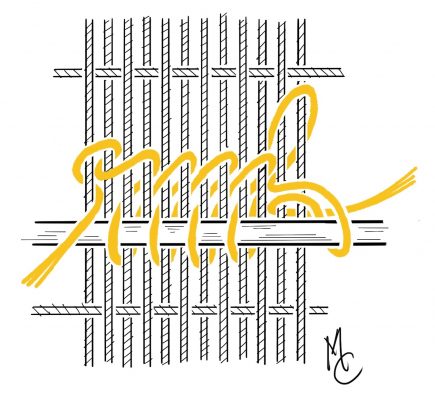
A rough illustration the Tibetan knotting technique of a handknotted carpet. The black vertical lines represent the warps of the carpet whereas the yellow represents the yarn which comprises the finished pile. Two horizontal weft yarns (top and bottom) add critical structure to carpet weaving. Tibetan weaving employs a metal rod (illustrated as the large horizontal line – middle) which is used to gauge pile height. It is either cut from the pile or pulled out depending on whether a cut or a loop pile is desired. Each yellow loop crossing the rod represents one knot, each tied meticulously by hand. | Illustration by Michael Christie, The Ruggist.
A rough illustration the Tibetan knotting technique of a handknotted carpet. The black vertical lines represent the warps of the carpet whereas the yellow represents the yarn which comprises the finished pile. Two horizontal weft yarns (top and bottom) add critical structure to carpet weaving. Tibetan weaving employs a metal rod (illustrated as the large horizontal line – middle) which is used to gauge pile height. It is either cut from the pile or pulled out depending on whether a cut or a loop pile is desired. Each yellow loop crossing the rod represents one knot, each tied meticulously by hand. | Illustration by Michael Christie, The Ruggist.